Last year, I had the opportunity to visit the Vatican Archives in Rome, Italy, through the Sangalli Institute.
I attended the “The Archives of the Holy See and the Roman Catholicism: instructions for use and new research perspectives” winter seminar for a week in January 2024. I had intended to post a blog post about the experience, the archives I toured, notes of the lectures, and the wonderful people I met, much earlier. However, life got busy, so I am only now writing up about my time at the Vatican Archives.
I’ll talk about the archives in further depth later, since I’ll mainly be talking about the experience of being in Rome during this post.
While I have travelled and lived internationally before, I have never been to Italy before. After I received the acceptance to the seminar, I remember having trouble accepting that I was going to Italy. Was Italy a real place? What was Italy? The geographic and political place was obviously solid and tangible. My education, which had imparted an appreciation of Roman history, Italian cuisine, Renaissance Art and Literature, Humanism, and the Latin language, on some level made it difficult to think about Italy as a modern country, with its own problems and successes, rather than an extension of historical study. I had to pull apart the layers. Through my initial shock at being accepted, I was excited to engage with the contemporary country.
In addition, I had to process that I would gain entrance to The Vatican Archives. The Archivio Apostolico Vaticano site indicates that the title of the Vatican Secret Archives dates back to its founding with Pope Paul V, in the sixteenth century. The purview of this official Vatican Archives often included surviving medieval manuscripts. That said, I was in awe that I was about access archives that historically very few beyond the clergy had the opportunity to see. I needed a minute.
I arrived in Rome, bag in hand, on a Sunday night. I had practiced some Italian on Duolingo. I hoped it would be enough to order… un espresso? Un cornetto? I had no idea what I would be in for. The Sangalli Institute said that we needed some Italian in the application.
Thankfully, the cab driver spoke English, as I told him I needed to go to the Catacombe di San Pancrazio, or the Catacomb of Saint Pancras. As we got a bit closer to the destination, the driver became a little confused. The catacomb? Yes.
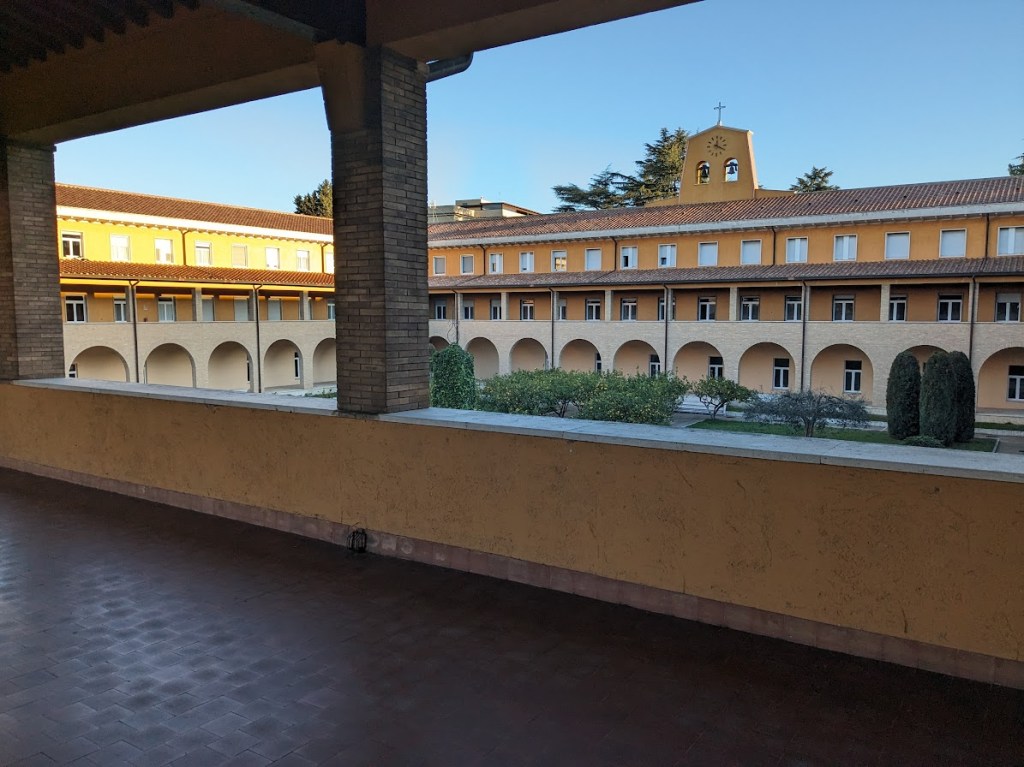
The Sangalli Institute had organized for the seminar group to stay at the San Pancrazio complex, which included a basilica, crypt, and the home of the Discalced Carmelites. In addition, the complex included a housing wing for the seminary students, where we would be staying.
The cab driver drove up a long drive and dropped me off in front of the basilica. I had no idea where I was supposed to go, though I had confirmed the address multiple times. I was supposed to meet with Fr. Evangelisti, who would direct me to my room. Two Carmelite brothers saw me just standing there, with my suitcase, and asked what was going on. I told them I needed to speak with Fr. Evangelisti. One of them took me across the courtyard to a tall stone wall and a big, green gate, which he opened with a key. The gate opened into a monastery set within a green expanse. The brother showed me how to enter the monastery and gave me Fr. Evangelisti’s phone number.
Fr. Evangelisti was a sweet elderly gentleman. He spoke little English, and since I spoke little Italian, we just laughed as we tried to make sense to each other with what words we did know of each other’s language. I tried to pull on my various levels of Latin, French, Spanish, and that little Duolingo Italian. I most likely made a hash of a very beautiful language. Ultimately, some meaning was conveyed, as I was given a brief tour of the grounds and the key to my room.
Reader, I took a nap.
The monastic complex was gorgeous. Some days, I contemplate taking a vow just for the quiet and ability to leave the hustle and bustle of the world. However, I can still consider the beauty of human effort in creating that space.
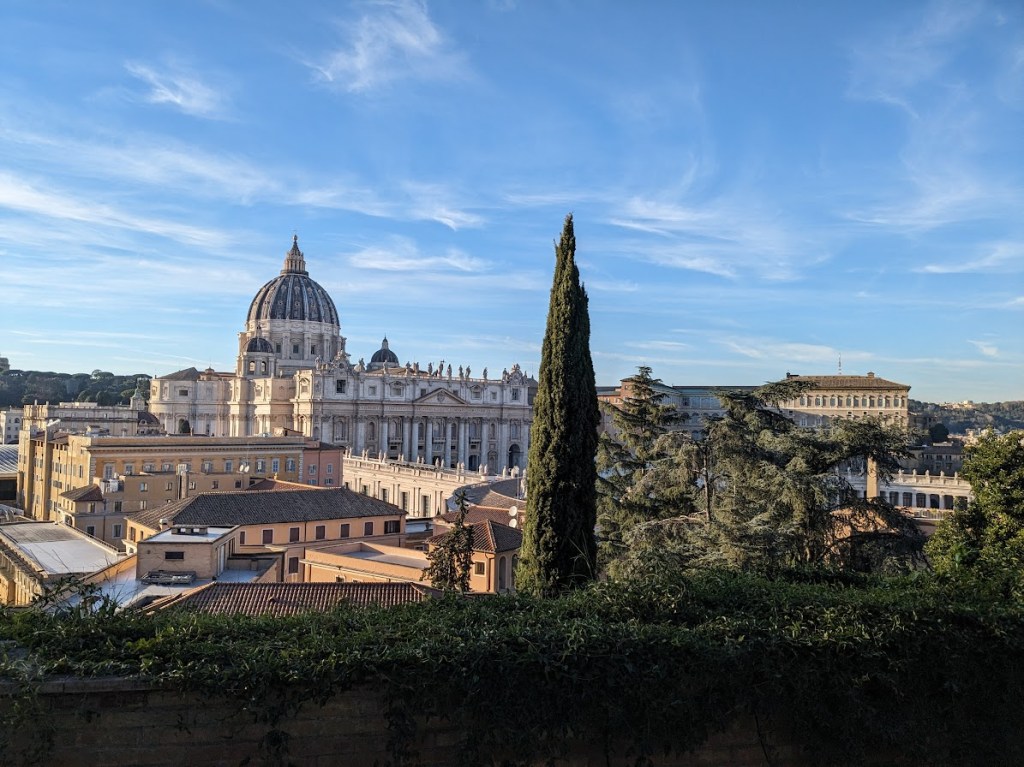
Rome is the city built on seven hills, which is not an overstatement. The San Pancrazio monastery was located on a hill. As we descended toward the city center, we could see the morning light brighten the ancient domes in the valley.
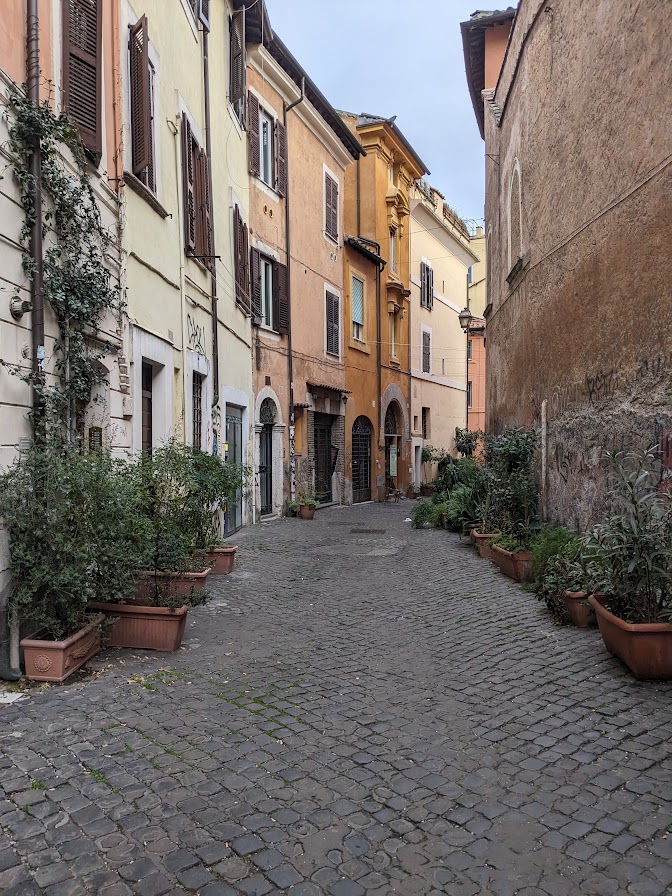
On the way to Barnabite Complex of San Carlo ai Catinari, we would have to pass through Trastevere, which is a boho, artsy area of Rome. The early morning (9am) streets were empty. The architecture was old, and the streets were cobbled. Even in January, green vines and plants wove their way down the sides of the walls. We crossed the Tiber and entered the Roman city center.
On Monday, I walked to the Roman center to find our meeting place, Barnabite Complex of San Carlo ai Catinari, which was a beautiful, old building.
At around noon, we stopped for an espresso break. We then had another lecture, after which we stopped for an hour lunch. Often, members of the group would mill around the Roman center and find a restaurant that we liked. The food was indeed amazing.
Thereafter, we followed the seminar leaders, Prof. Sangalli and Prof. Binasco, to the Archive destination of the day. Rome is ancient and large, but for the most part it appears to be walkable in about thirty or forty minutes. We almost never took transport of any sort, since we could walk to our destination. However, the January air was brisk and sweet as our group made our way to the sites.
The city woke up and slowly began to hum, like a Vespa going up a steep hill. We entered Rome through Trastevere, which was relatively empty in the morning. In the city center of Rome (please forgive my geography!), by the Barnabite Complex, the cafés that lined the streets showed more signs of life, as people would enjoy an espresso, pastry, and a conversation among their peers. By noon, a mercato (market) had been set up by the Barnabite Complex.
Our group broke at noon for an espresso break, where we stood at a bustling, noisy café counter and drank a quick shot, for energy, before heading back for another round of lectures. The streets of Rome in the afternoon were filled with residents and tourists; however, buildings such as the Pantheon were so big and so old that the masses of people seemed miniscule. During the lunch break, we would often take a walk around a cathedral, where reliquaries and art from the Old Masters sat open for public devotion.
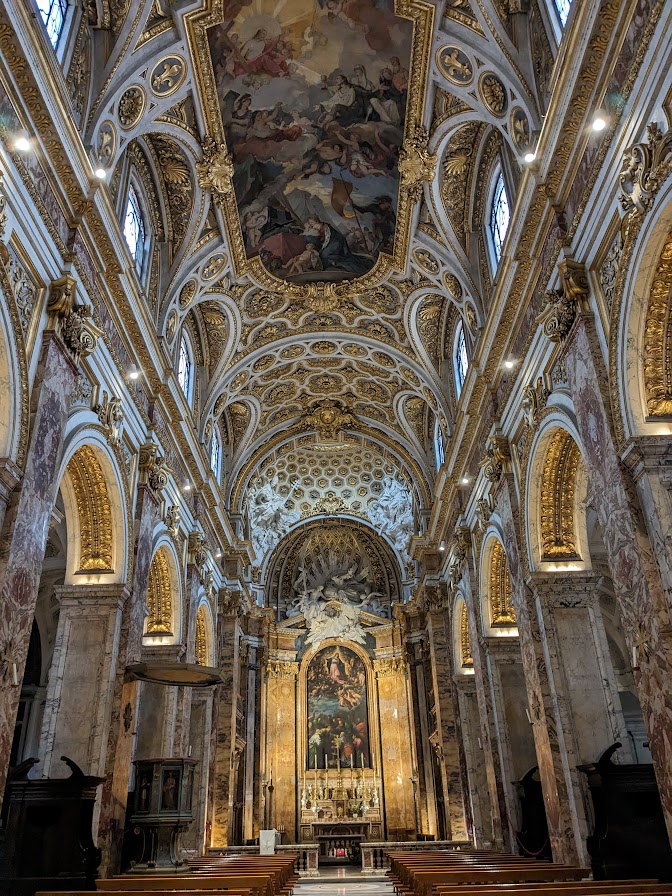
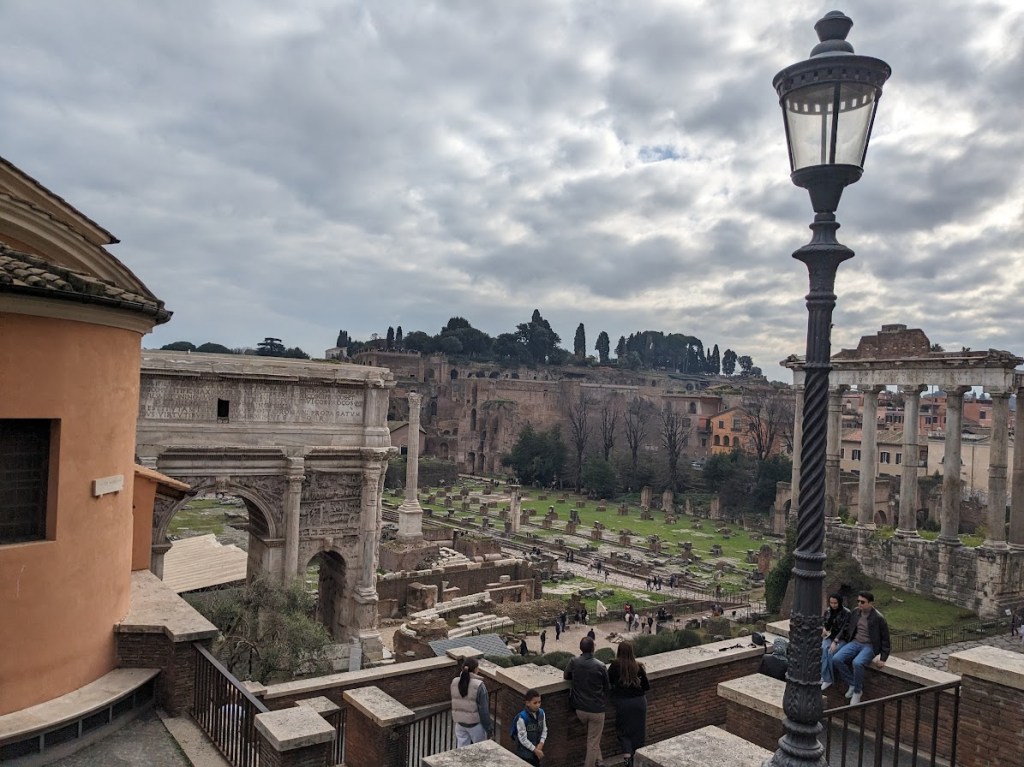


I felt so small beneath the golden ceilings of the churches. I felt so small and yet I wanted to stay fixed in place within the crowds. It was impossible to avoid a sense of devotion, awe, or at least overwhelm.
By late evening, the hum of the crowds had reached its greatest pitch. Dinner started late in the evening, around 7 or 8pm, just as Rome’s nightlife had just begun. At this point, our group––generally, in pockets of three or four people––had the freedom to explore the central city. We made our way through city streets.
When our group made our way back to the monastery through Trastevere, the lamplit streets were still filled with the linger of laughter and music. As we walked into the monastic compound, the moon cast a shadow on the lemon and orange trees of the interior garden.
I made friends quickly during the seminar, and the Cat Sanctuary in Rome may be to credit in part for some of those friendships. Also, cats. Everyone has to know about the cats.
The cat sanctuary is located in the middle of Rome. It is a preserved ruin, which was the original site of the Forum, and the location of the assassination of Julius Caesar. Currently, the site is preserved and protected from the general public by a fence. Modern shops surround the location.
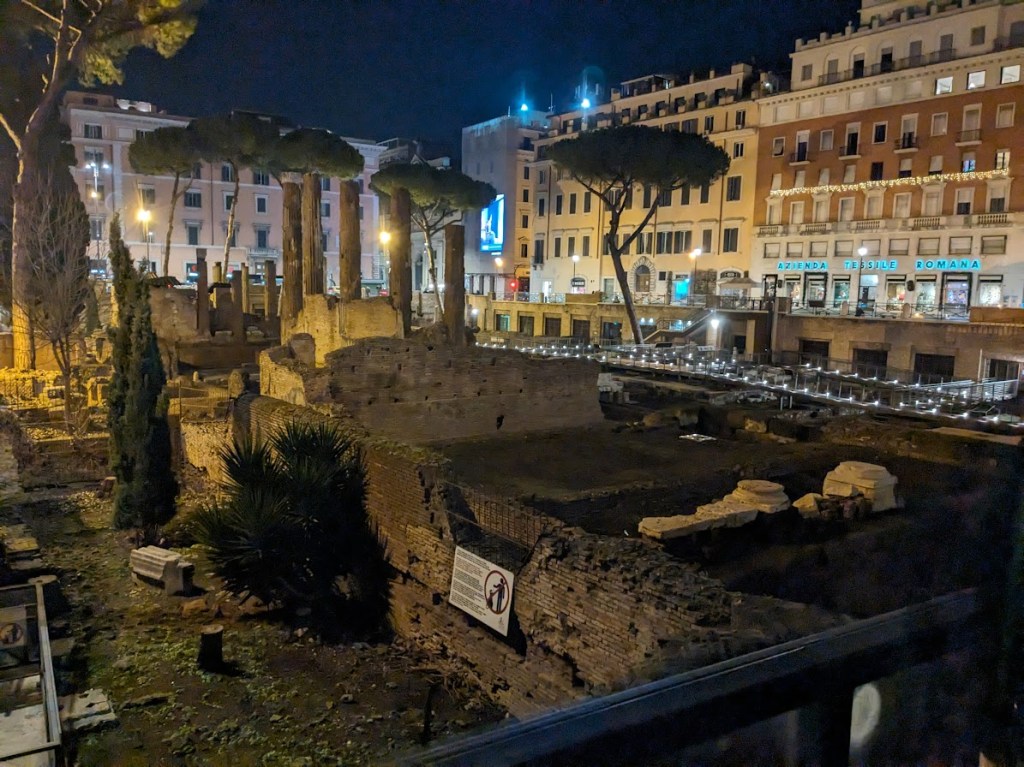
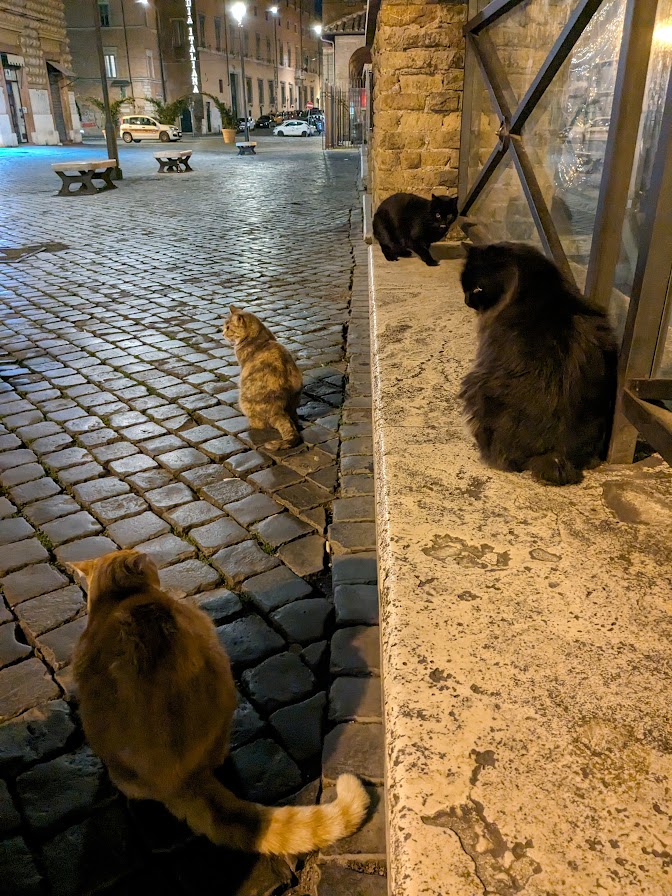
Most importantly, the site is now home to Rome’s stray cat population, where they are guaranteed care by the city. I visited the ruin with some members from the group, at which point we started goo-gooing over the cats. We could have cared less that there was a famous ruin before us. There were cats. Since the kitties were quite used to star treatment, they did not of course come when we called. They preferred to lounge beneath the stars on a fallen monument, almost out of site.
One of our group managed to call the cats in a special way, and then all the cats climbed onto the street. We were able to pet a couple of cats and sit near them on a bench as they stretched out. They are, after all, discerning creatures. At some point, the cats had reached their fill of caresses and hopped back into the ruin.
I keep everything that happened during that week close to my heart, but several events rise close to the surface as particularly poignant. While I have been to several academic seminars and conferences, I have to say that I have never been to one that encouraged camaraderie and collaboration among the group as much as this particular seminar. Usually, I have to accept periods of loneliness and solitude as the price of academic learning. It is a price I have learned to pay for scholarship.
For the seminar with the Sangalli Institute––whether by luck or design––our group quickly got along, were quickly chummy and helpful, and in some cases have remained in contact through social media. As much as I appreciated access to the Vatican Archives, I also deeply value the connections I have made with my peers and fellow researchers.
 Medieval Scripts and Scraps
Leave a comment