The Medieval and Renaissance 29 Book of Hours, miniature, fifteenth century, is one of the more beautiful manuscripts in the Lilly Library at Indiana University-Bloomington. I stumbled across it while doing a project for a Rare Books course in the MLS program and promptly fell in love. As you can see below, the paintings in the manuscript are vivid, highly decorated, and very fine. I am personally partial to the Virgo Lactans, which is featured as the main photo for this blog. The manuscript is surprisingly readable and offers an intact Book of Hours and Calendar, the study of which is helpful to understand the use and origin of the manuscript.
This blog post will provide a brief review of the Medieval and Renaissance 29 Book of Hours, miniature, fifteenth century with a short study of its panel artwork and artists. In addition, I will provide a transcription and discussion of its calendar.
The Medieval and Renaissance 29 Book of Hours, miniature, fifteenth century is a small, unassuming manuscript, no bigger than a hand. According to Christopher de Hamel, who surveyed the manuscripts of the Lilly Library in Gilding the Lilly, it measures 121mm by 83mm and contains 219 leaves. The script throughout the miniature is in a very readable lettre bâtarde; the ink in the calendar alternates between red, blue, and a gold, while the Hours are in a brown ink. The manuscript includes fifteen miniatures in panels, some of which are full sized. The binding is a late sixteenth-century French dark morocco gilt with gilt edges, lacking ties.1
The manuscript is in fine condition, though some wear and fading of the ink is visible on the final page of the calendar, which may arise from use of the manuscript during Advent. A panel miniature is on the recto side across from the faded calendar entries (verso side), so the lack of a dividing page may have allowed for the ink to be rubbed away with time. Otherwise, the most remarkable sign of use is the defacement of signs of ownership. A large, deliberate scratch has been dug into the vellum on the first page of the calendar, which most likely obscures the name of the manuscript’s owner. The coat of arms under the Virgo Lactans [r37] has been smeared out. Christopher de Hamel has tentatively identified the manuscript as belonging to Philippe de Longwy or his brother Etienne de Longwy, of the Burgundian Longwy family, because of the azure a bend still visible in the coat of arms.2 Despite the lost signs of ownership, the manuscript still provides ample signs of provenance in its Hours, paintings, and calendar.
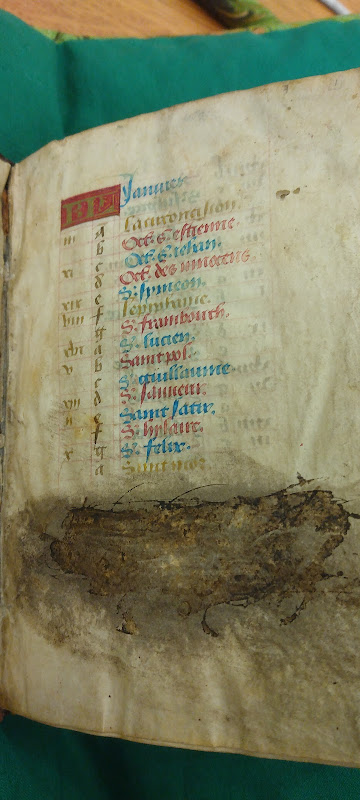
January with the crossed-out coat of arms
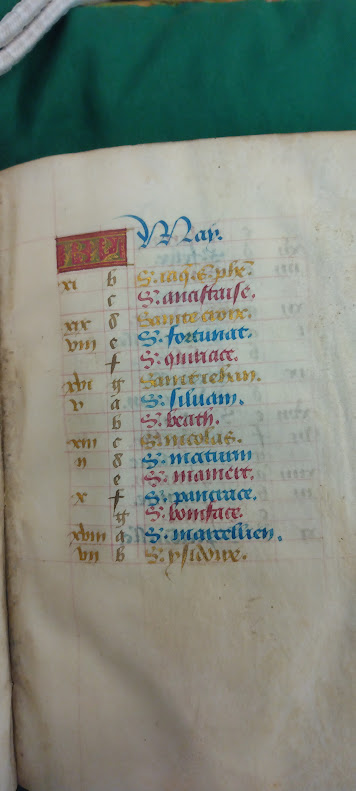
The month of May with feast days
Christopher de Hamel has identified the origin of Medieval and Renaissance 29 Book of Hours as definitively “Use of Tours” because of its order of Hours. De Hamel indicates that Medieval and Renaissance 29 incorporates a practice called an heures mixtes, which adds onto an English practice of combining the Hours of the Cross and the Virgin. In these heures mixtes, which are particular to Tours, “the full cycles of the Hours of the Cross and the Holy Ghost are incorporated in parallel right through from Lauds to Compline of the Hours of the Virgin.”3 De Hamel indicates that the Litany and Suffrages indicate an origin of Tours, since they include Saints Gatian, Martin, Brice and Lidorius, and Julian, who are patrons of or derive from Tours.4 De Hamel compares Medieval and Renaissance 29 Book of Hours to another, similar Book of Hours, by Etienne Chevalier and Jean Fouquet. The close resemblance between the two manuscripts and their artistic fineness has constituted part of de Hamel’s assessment of the Lilly’s manuscript.
According to de Hamel, the miniatures in the Medieval and Renaissance 29 Book of Hours may have been painted by Jean Fouquet of Tours or those within his circle. He identifies the paintings as completed by three artists. He indicates that most miniatures are in the hand of Master of Vienna Mamerot, though the style follows closely Jean Fouquet. He adds that a prominent Tours feature in the miniatures is the use of “hazy mauve skies.”5 De Hamel indicates Jean Bourdichon of Tours, a follower of Fouquet’s style, as the artist of the manuscript’s “Saint John of Patmos.”
Fouquet may have painted the Virgo Lactans miniature [r37], since he appeared to favor this form of Madonna and child, especially since it appears to be a copy or in the same hand as the Hours of Simon de Varie by Fouquet, now in The Hague.6 The close attention to detail and fine handiwork of Jean Fouquet is preserved in the style of the Medieval and Renaissance 29 Book of Hours, the composition of which allows us to consider similar works in the fifteenth century.
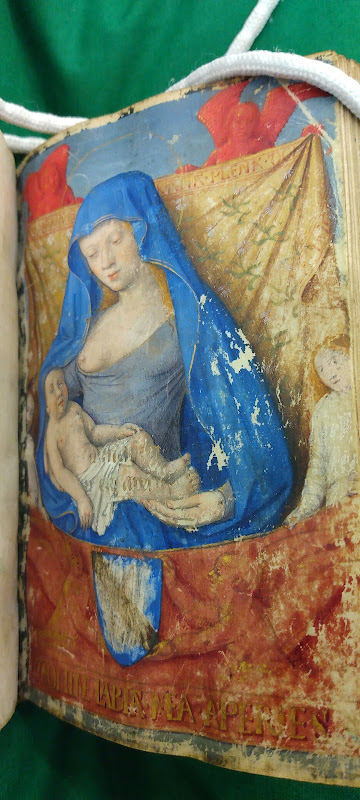
Virgo Lactans. Below is the azure a bend which may indicate ownership..
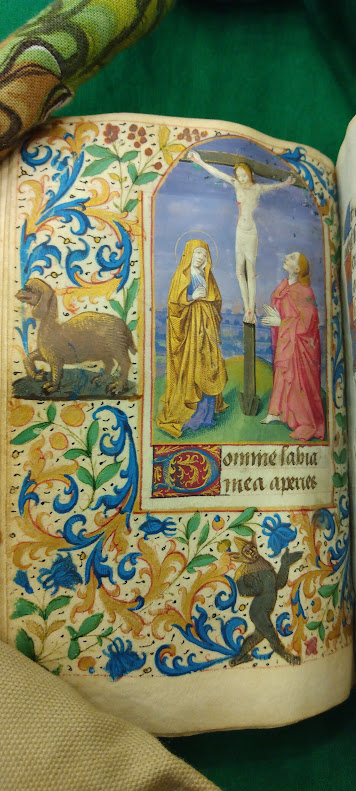
Crucifixion
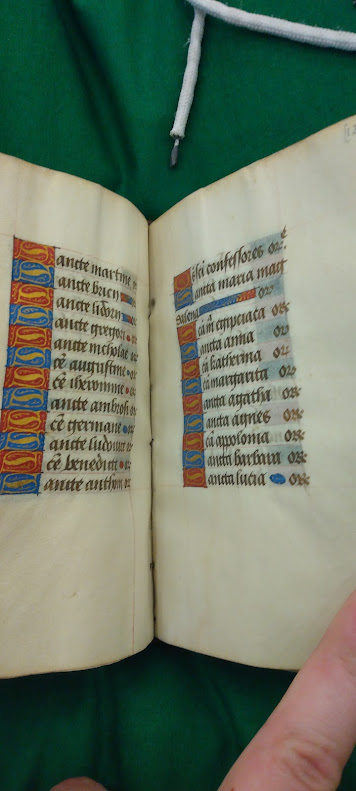
Book of Hours Suffrages
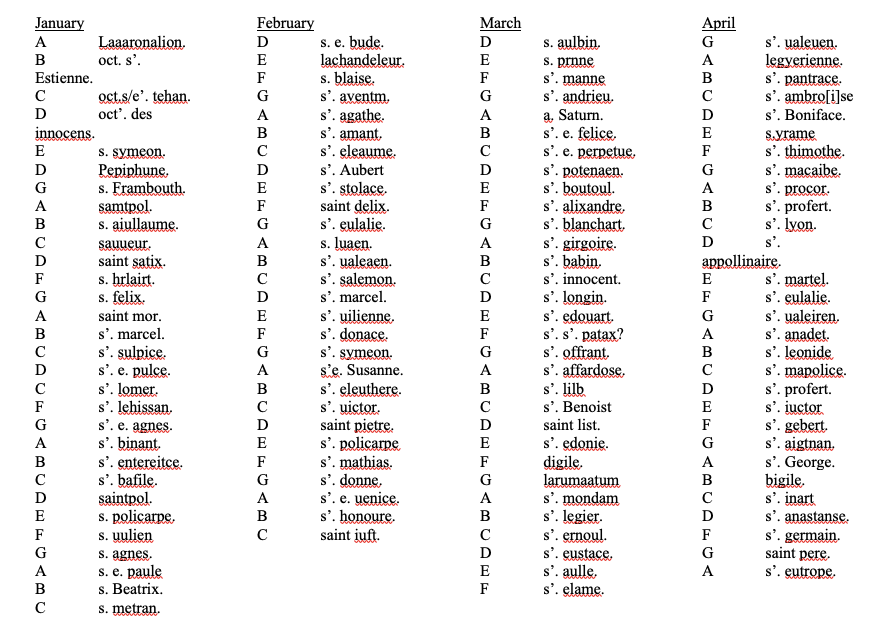
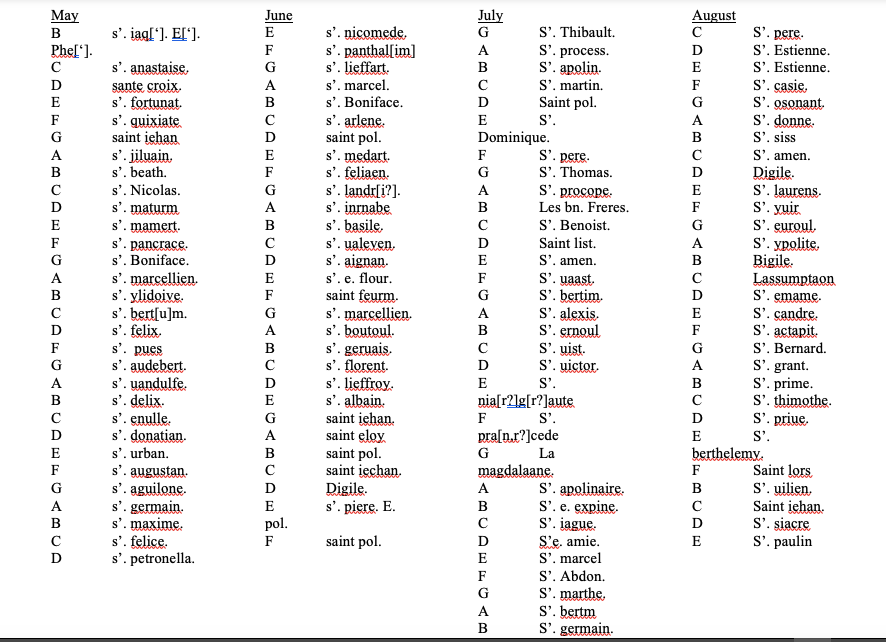
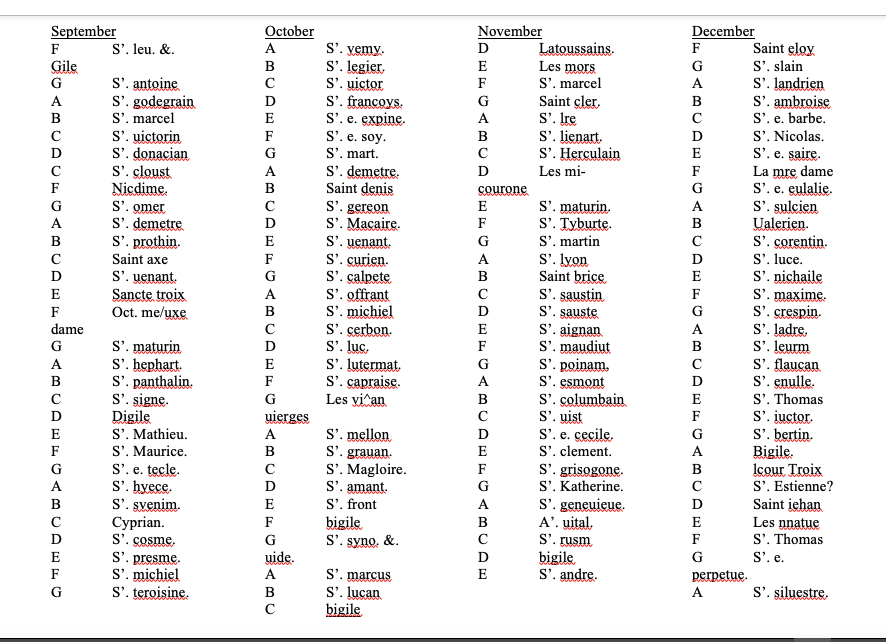
As a Book of Hours, one of the most important aspect of the manuscript is of course its calendar. The calendar in the Medieval and Renaissance 29 is complete. The fullness of the calendar is helpful in locating the manuscript’s possible origin and use by its owner. Even as late as the fifteenth century, the veneration of local saints can help identify manuscript use, since the lists of saints were not entirely standardized. A useful resource for comparing the calendars of Books of Hours can be found at the Corpus Kalendrum, which allows scholars to compare the calendars of multiple Books of Hours from various institutions simultaneously. Such a tool has been very helpful in doing research with the Medieval and Renaissance 29 Book of Hours, miniature, fifteenth century.
In scanning through some select calendars on the Corpus Kalendrum (Oberlin Artz Hours, the Morgan MS M. 141, Latin 1202, Typ 614, Comites Latentes 124, MS. Lat. 34, Hours of Louis de Laval, 1949-83-1, and the Hours of Charles VIII), the calendars that originate from or are Use of Tours or Rome include far fewer saints in their calendars. The Medieval and Renaissance 29 does not appear to correlate with these Books of Hours except for the common feasts. Since Medieval and Renaissance 29 more closely resembles the lists of saints in calendars of Use of Paris, the Medieval and Renaissance 29 may be closer to Use of Paris or an amalgamation of various calendars.
More work is certainly needed on this manuscript. The project offers the tantalizing prospect of Jean Fouquet’s workshop in Tours but the complicating factors of a calendar that appear to be Use of Paris. The manuscript contains a number of unknowns, such as the exact details of the commission. In addition, contemporary manuscript workshops could certainly have been mobile, so the artisans could have shuttled between Tours and the Left Bank of Paris.
Below I have posted the transcript for the calendar of the Medieval and Renaissance 29. Happy reading!
Footnotes
- De Hamel, Christopher. Gilding the Lilly: A Hundred Medieval and Illuminated Manuscripts in the Lilly Library. Bloomington, IN: Lilly Library, 2010. pp 164. ↩︎
- Ibid, 165. ↩︎
- Ibid, 164. ↩︎
- Ibid. ↩︎
- Ibid. ↩︎
- Ibid, 167. ↩︎
Sources
Artz Book of Hours. Oberlin College Library. Special Collections. https://cdm15963.contentdm.oclc.org/digital/collection/illumina/id/1752
Comites Latentes 124. Bibliothèque de Genève. Geneva, Geneva CH. http://www.e-codices.unifr.ch/en/list/one/bge/cl0124.
De Hamel, Christopher. Gilding the Lilly: A Hundred Medieval and Illuminated Manuscripts in the Lilly Library. Bloomington, IN: Lilly Library, 2010.
Latin 920. Bibliothèque nationale de France. Paris, Ile de France FR. https://gallica.bnf.fr/ark:/12148/btv1b52501620s.
Latin 1202. Bibliothèque nationale de France. https://gallica.bnf.fr/ark:/12148/btv1b84469449.
Latin 1370. Bibliothèque nationale de France. Paris, Ile de France FR. https://gallica.bnf.fr/ark:/12148/btv1b10464105m
Medieval and Renaissance 29. LMC 2450 Book of Hours, miniature, fifteenth century. Medieval and Renaissance mss., Lilly Library, Indiana University, Bloomington, Indiana.
MS. Lat. 34. Bibliothèque de Genève. Geneva, Geneva CH. http://www.e-codices.unifr.ch/en/list/one/bge/lat0034.
MS M.141. Morgan Library. New York, New York US. http://corsair.themorgan.org/vwebv/holdingsInfo?bibId=77054
Typ 614. Harvard Houghton Library. Cambridge, Massachusetts US. https://hollis.harvard.edu/primo-explore/search?tab=everything&search_scope=everything&vid=HVD2&lang=en_US&mode=basic&offset=0&query=lsr01,contains,009853969
 Medieval Scripts and Scraps
Leave a comment